
《电子技术应用》
您所在的位置:首页 > 嵌入式技术 > 设计应用 > 嵌入式定量定速哈希表的实现方法
嵌入式定量定速哈希表的实现方法
集成电路应用
任文龙,姚力,陈路
四川九洲电器股份有限责任公司701部
摘要: 多数面向小内存的嵌入式操作系统在设计时遵循简洁高效原则,一般不支持内置的哈希表数据结构,限制了哈希表在嵌入式软件中的设计与应用。不同嵌入式系统的内存管理效率和哈希操作效率问题也给哈希表的应用带来了一定的挑战。针对以上问题,该文设计了一种适合于嵌入式系统的定量定速哈希表实现方法,该方法基于操作系统的静态内存区构建一个算法复杂度为O(1)的动态内存机制,并在此基础上改进链接法的哈希实现结构,加入用于存储键值的双向链表,在CRUD操作上实现和传统链接法相同的算法复杂度。经测试,结果表明其实时性强且具备较高的实用价值。
中图分类号:TP872文献标识码:ADOI:10.19339/j.issn.1674-2583.2026.08.005
中文引用格式:任文龙,姚力,陈路.嵌入式定量定速哈希表的实现方法[J].集成电路应用,2026,43(8):22-27.
英文引用格式:Ren Wenlong,Yao Li,Chen Lu. Implementation method of embedded quantitative constant-speed hash table[J].Application of IC,2026,43(8):22-27.
Implementation method of embedded quantitative constant-speed hash table
Ren Wenlong,Yao Li,Chen Lu
Department 701,Sichuan JiuZhou Electronics Co. Ltd.
Abstract: Most small RAM embedded operating systems which follow the principle of simplicity and efficiency usually don’t support built-in hash data structures, and this limits the design and application of the hash table structure in the embedded software. It’s also a challenge for embedded hash table application because of the memory management efficiency of different embedded operating systems and that of the hash table operation. This paper designs a quantitative constant-speed hash implementation method for the embedded system. It constructs a constant O(1) dynamic memory mechanism using the global static memory segment. Based on this, the algorithm adds a dual linked list for storing the key and improves the structure of chain hash which has the same complexity with the traditional chaining hash algorithm when executing the CRUD operation. The algorithm is tested and the results show that it has excellent real-time performance and high practical value.
Key words : embedded system; hash table; chaining; static memory segment; dual linked list

引言

在嵌入式软件处理中,数组是最基础和最常用的数据结构,其适合于存储和处理有规律的顺序数据。哈希表[1]是一种性能优异的数据结构,在无序的数据处理中,哈希表往往较数组有更大的灵活性和易于理解的表达形式,因而在计算机系统中得到了广泛的应用,其查找速度快,常用于数据检索等方面。在类似航迹处理、目标跟踪等需要快速检索和遍历的嵌入式软件中采用数组的方案将会带来高复杂度的软件设计,给后续的维护工作带来极大不便。为了满足嵌入式软件设计的高可读性和高可维护性,在软件设计时直接应用计算机领域成熟的数据结构和算法(如队列、链表和哈希表等)是较好的方案,但目前许多嵌入式操作系统(如FreeRTOS和DSP/BIOS[2])无法直接支持这些常见的算法,需要用户自主实现;同时,嵌入式设备有限的计算能力和较小的内存资源降低了这些算法的可移植性和性能表现,进一步限制了这些算法的应用。因此,如何设计一种适合于小内存嵌入式操作系统的哈希表实现方法具有实际意义和研究价值。

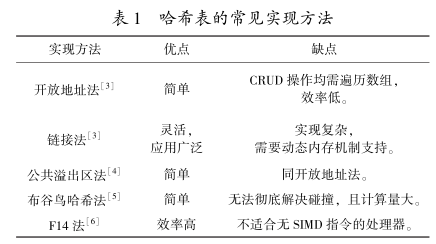
哈希表理论上的CRUD操作平均时间复杂度是O(1),但不同的哈希表在实现上仍然存在巨大的性能差异。因此工程师们对更优性能的哈希数据结构的探索也从未停止。目前哈希表的几种常见实现方法优缺点见表1。
无标题.png

本文在传统的链接法实现结构上加入了用于存储键值的双向链表,实现了在遍历操作上具备和数组相同的算法复杂度,与此同时针对嵌入式操作系统动态内存管理潜在的不可用问题进一步设计了一个基于全局字节数组的独立高效动态内存管理器以支持链接法哈希表。在飞腾FT6416平台上实现该方法,并给出了该方法的性能测试结果。


本文详细内容请下载:

https://www.chinaaet.com/resource/share/2000007319


投稿邮箱:ICAPP@belling.com.cn


作者信息:

任文龙,姚力,陈路

(四川九洲电器股份有限责任公司701部,四川绵阳621000)

2.jpg

此内容为AET网站原创,未经授权禁止转载。